Technical Article
Technical Article
Data Minimization and PII Protection in Observability Pipelines
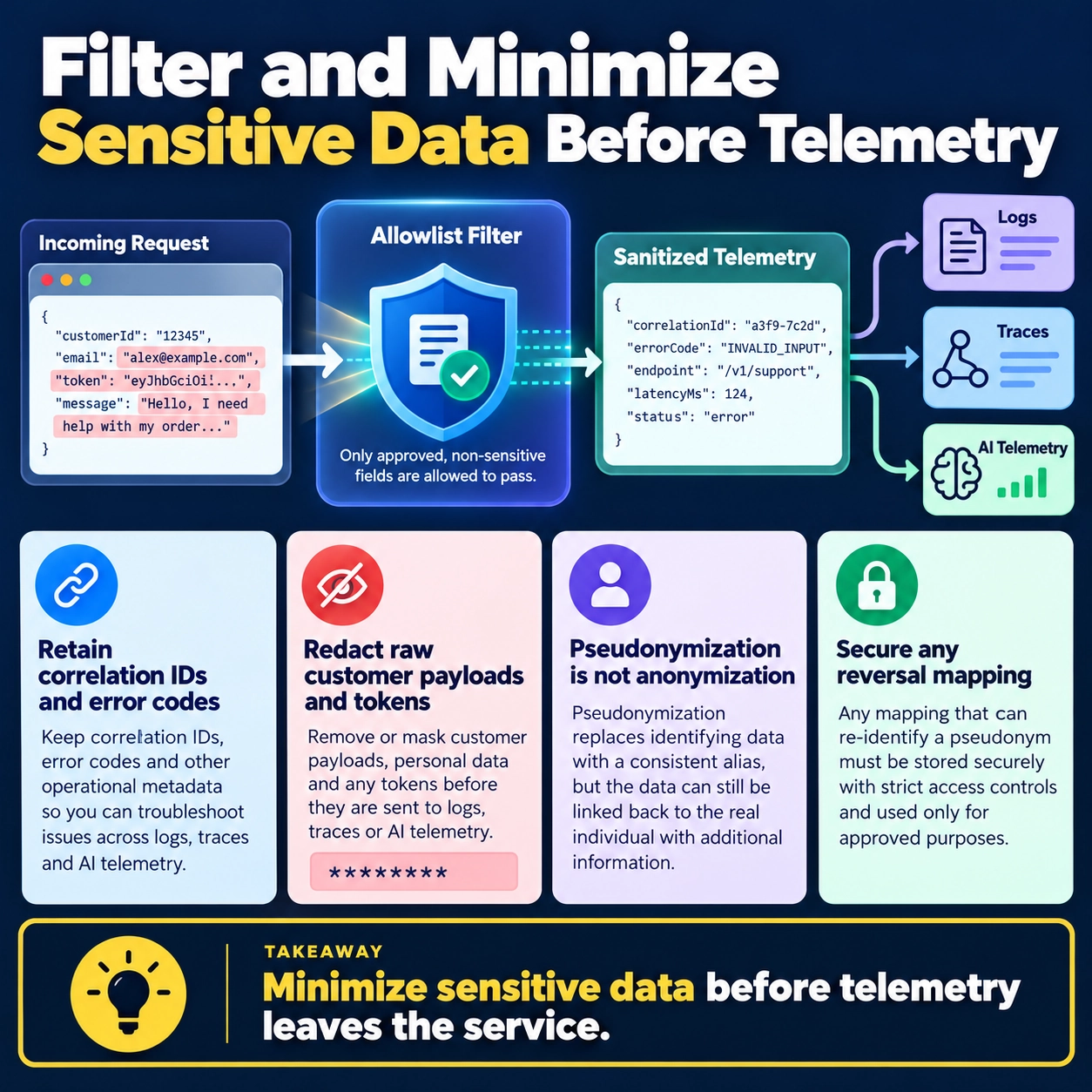
Your primary database may be fully encrypted, protected by strict access controls, and audited continuously, while that exact same personal data circulates freely across observability tools, all because a single logger.info(payload) call created an unmanaged secondary store of sensitive records.
Consider an operation processing documents containing names, addresses, and personal identifiers: the service logs the entire request, distributed tracing spans capture customer attributes, and an AI workflow reuses that payload to build a prompt.
Observability as an Unintended Data Sink
The consequence is not merely data duplication. It creates new attack surfaces governed by disparate access controls, retention schedules, and third-party SaaS vendors that bypass your core operational boundaries.
The solution begins before telemetry ingestion: structured logging should enforce explicit operational allowlists. Correlation IDs, entity states, and error codes provide sufficient context to diagnose incidents without persisting raw documents, auth tokens, or customer payloads.
Trace Spans, Prompts, and AI Workflows
This filtering policy must span the entire telemetry lifecycle. Distributed tracing span attributes, exception messages, LLM input prompts, and model completions routinely leak personally identifiable information (PII) to external observability sinks with independent retention policies.
When an AI workflow requires tracking entities across multi-step execution, deterministic pseudonyms such as [PERSON_1] and [PERSON_2] preserve relational context while stripping direct identifiers, provided the reversal mapping is secured in an isolated vault accessible only to authorized components.
Pseudonymization vs. Data Minimization
Pseudonymization is not anonymization. Rich contextual clues and quasi-identifiers can still enable re-identification. When an operational task does not strictly require detokenization, complete data minimization or redaction is far safer than maintaining a reversal key.
Observability should never transform routine incident investigations into data breach liabilities. A resilient architecture explicitly defines what telemetry crosses network boundaries, sets enforceable retention policies, and restricts access according to strict principle of least privilege.
AI Disclosure: The ideas and content are my own. I use LLMs to improve clarity and polish my writing.